Required Tools and Equipment:
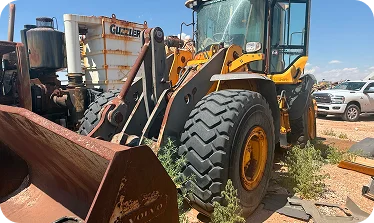
- A piece of heavy equipment like a telehandler, skid steer, Front end loader, Crane, etc.
Procedure for loading Flatbed trucks:
- Ensure that the truck has a weight ticket showing the truck’s empty weight if applicable.
- Have the driver move as close to the rolls as possible while still giving room for the heavy equipment to maneuver as it loads.
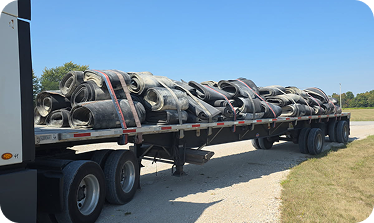
- Load the rolls of belting using proper lifting procedure for whatever equipment is being used to load.
- Once the rolls are loaded ensure that the driver straps the rolls down.
- Before loading is finished, ensure that the net weight is at least 40,000lbs or more.
- Check the weight by sending the truck to a truck scale and subtracting the heavy loaded weight from the light empty weight.
- Continue loading until there is at least 40,000lbs of belting loaded onto the truck.
Procedure for loading shipping containers and enclosed dry van trailers:
- Ensure that the truck picking up the belting has a weight ticket showing the truck’s empty weight if applicable.
- Have the driver move as close to the rolls as possible while still giving room for the heavy equipment to maneuver as it loads.
If loading using a loading dock:
- Simply load the bare rolls of belting into the container using a forklift
- Secure loose flaps of belting with a few screws if needed
- No packaging is ever required
- Ensure that the necessary amount of material is loaded (at least 22-24 tons typically)
- Determine weight by sending the truck to any truck scale and comparing the full weight after loading with the empty weight.
If loading from the ground and a telehandler is used:
- Ensure that the truck picking up the belting is on level ground or facing slightly downhill.
- Begin loading rolls and ensure that the first few rolls are placed all the way to the back of the container. If the forklift cannot extend far enough to get the rolls to the back of the container. Then set the rolls down and push them in. If needed, use a large piece of timber or something similar to assist in gently and carefully pushing the rolls to the back of the truck.
- Be sure to stack rolls on top of each other wherever possible to help maximize weight.
- Continue loading until the necessary weight is achieved. (Usually 22-24 tons)
- Determine weight by sending the truck to any truck scale and comparing the full weight after loading with the empty weight.
If a telehandler is not used:
- Ensure that the truck picking up the belting is on level ground or facing slightly downhill.
- Place a pallet jack inside the container and place rolls of belting on the pallet jack
- Use the pallet jack and a few blocks of wood to maneuver rolls to the back of the container
- Continue using the pallet jack to move rolls to the back of the container until the whole container and loaded to the necessary weight
- If a pallet jack is not available, sometimes the rolls can simply be rolls to the back as long as the rolls are tight and the truck is pointed slightly downhill.
- Make sure the truck isn’t pointed too far downhill.